GEO: how to get your site cited by ChatGPT, Perplexity and Gemini
 By Thierry Gustin
Published
5 min read
Contents
To get cited by ChatGPT, Perplexity or Gemini, your site has to be accessible to their bots, easy to understand and easy to quote. That’s what GEO, optimization for AI answer engines, is all about. Here’s how these tools choose their sources, followed by the practical method, both writing and technical, that I built into Éclair.
What is GEO, and how is it different from SEO?
GEO, short for generative engine optimization, aims for a place in a generated answer: when someone asks an assistant a question, it writes a summary and cites a few sources, often with a link. SEO, on the other hand, aims for a good position in a list of results.
The two complement each other more than they compete: a fast, well-structured page that ranks well also has a better chance of being read by answer engines.
| Criterion | SEO | GEO |
|---|---|---|
| Goal | Rank well in the results | Be cited as the source of an answer |
| Main reader | A human comparing links | A model extracting a passage |
| Winning format | A complete, relevant page | A direct, structured, sourced answer |
| Trust signal | Links, experience, authority | Identified author, figures, sources, freshness |
How do AI tools find and cite your pages?
They rely on bots, which fall into two very different families:
- answer engine bots, which read your pages to answer questions and cite their sources: OAI-SearchBot and ChatGPT-User (OpenAI), Claude-SearchBot and Claude-User (Anthropic), PerplexityBot and Perplexity-User, DuckAssistBot, MistralAI-User…
- training bots, which collect text to train future models: GPTBot, ClaudeBot, Google-Extended, Applebot-Extended, CCBot, Meta-ExternalAgent…
OpenAI documents these roles precisely: OAI-SearchBot makes sites appear in ChatGPT search, GPTBot is used for training, and ChatGPT-User corresponds to visits triggered by a user (OpenAI’s official overview of its bots, as of October 30, 2026). On Google’s side, Google-Extended is a separate token that lets you control how Gemini uses your content (list of Google’s crawlers).
Once the page has been read, the model looks for the passage that best answers the question: clear, self-contained, verifiable. That’s where writing makes the difference.
How do you write a page an AI wants to cite?
Here’s the method behind the GEO score in Éclair’s editor, criterion by criterion:
- Answer in the introduction, in fewer than 70 words: the question gets its answer before any digression.
- Add a “Key takeaways” summary of 25 to 90 words, displayed at the top of the article: it’s the passage an AI can quote as is.
- Phrase your subheadings as questions (“How much does… cost?”, “How do I…?”): they match the way people ask assistants.
- End with a FAQ: Éclair automatically marks it up as FAQPage in the structured data.
- Use lists and tables: data that’s easy to extract and compare.
- Give concrete figures: prices, durations, percentages, dates. Precise content is quotable content.
- Cite your sources with links to reliable pages.
- Sign your content: an identified author with a bio builds trust (the famous E-E-A-T).
- Write short paragraphs, under 120 words, each focused on one idea.
- Keep your pages up to date: a visible update date reassures readers and engines alike.
Which technical settings open your site to AI?
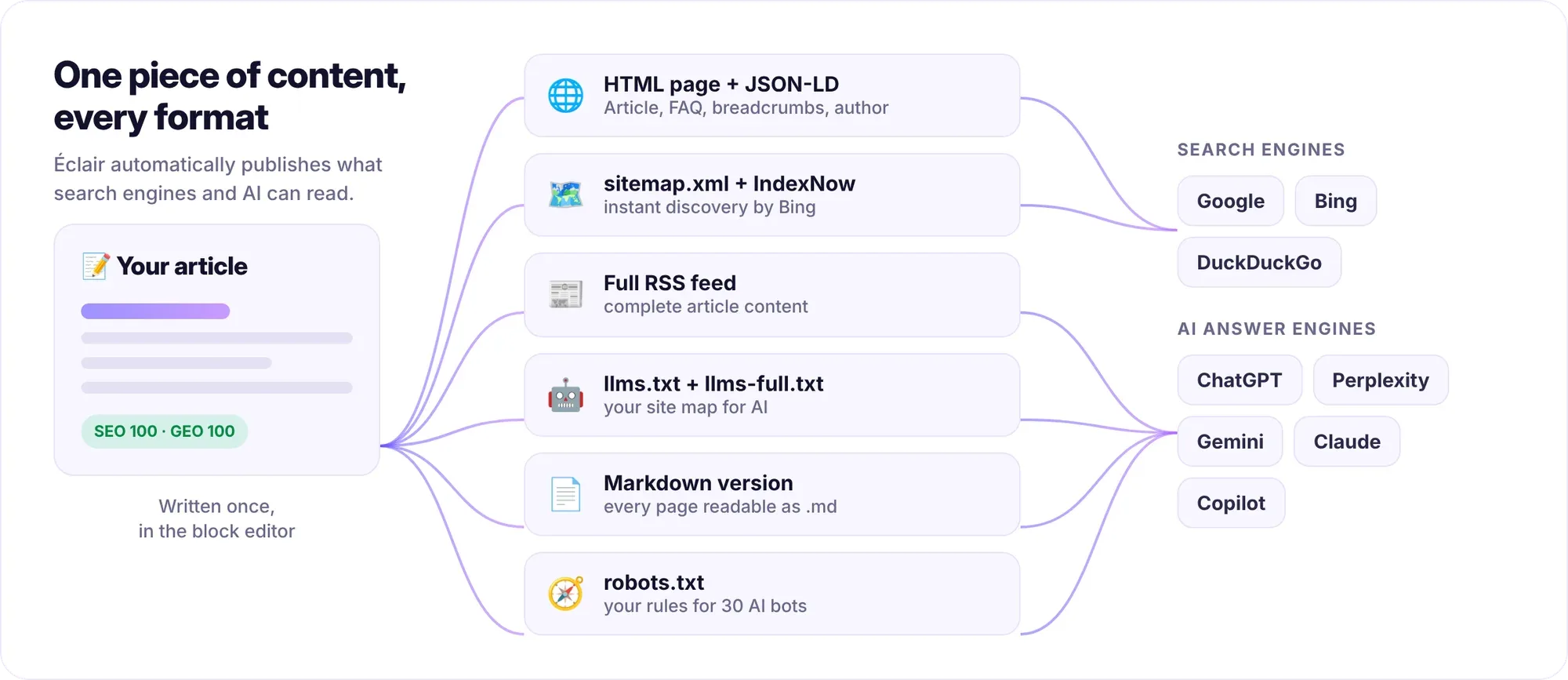
The best writing is useless if bots can’t read your pages. Éclair takes care of the technical side automatically:
- the robots.txt file, set in one click to one of three policies, for 30 known AI bots
- the
/llms.txtand/llms-full.txtfiles, generated according to the llmstxt.org proposal published by Jeremy Howard in September 2024: a map of your site in Markdown, designed for AI - a Markdown version of every page: add
.mdto any URL to get clean text, with a canonical URL and anoindexdirective to avoid any duplicate content - JSON-LD structured data: article, FAQ, breadcrumbs, author, organization
- a sitemap with IndexNow, which notifies Bing and other compatible engines every time you publish
Here’s a shortened version of the robots.txt that Éclair generates with the “Citations only” policy (its comments are written in French; robots ignore them):
# Moteurs de réponse IA : autorisés (citations et sources)
User-agent: OAI-SearchBot
User-agent: ChatGPT-User
User-agent: Claude-SearchBot
User-agent: PerplexityBot
Allow: /

# Entraînement de modèles d'IA : refusé
User-agent: GPTBot
User-agent: ClaudeBot
User-agent: Google-Extended
User-agent: CCBot
Disallow: /
An option also adds the Content-Signal directive, a Cloudflare proposal for stating your usage preferences. It isn’t standard, and Lighthouse flags it as unknown, which is why it stays off by default.
Should you block training bots?
It all depends on what you sell. Éclair’s three policies cover the common cases:
| Policy | Answer engines | Training | Who is it for? |
|---|---|---|---|
| Open (recommended) | Allowed | Allowed | Maximum visibility: craftspeople, small businesses, consultants |
| Citations only | Allowed | Refused | Your writing is your product, but you want to be cited |
| Closed | Refused | Refused | Restricted content, no AI visibility wanted |
For most small businesses, being open brings in more than it costs: a brand that models know well can more easily be recommended. If your content is what you sell (courses, books, studies), “Citations only” is a good compromise.
Can anyone guarantee you’ll get cited by ChatGPT?
No, and be wary of anyone who promises it. Each assistant picks its sources question by question, and its rules change often. GEO improves your odds; it doesn’t make anything certain.
The best test is still a simple one: ask the assistants your customers’ questions, look at which sources they cite, and improve your pages accordingly. Useful, precise, up-to-date content eventually finds its place, in Google and in generated answers alike.
For all of Éclair’s settings (bots, llms.txt, Markdown, GEO score), see the GEO page of the documentation, or explore all of Éclair’s features.
Frequently asked questions about GEO
Does GEO replace SEO?
No. Answer engines partly rely on the same signals: a fast, well-structured page that ranks well is also better placed to be cited. What GEO mainly adds is a demand for clarity and sources.
What is the llms.txt file?
It’s a map of your site in Markdown, intended for AI, following the llmstxt.org proposal. Éclair automatically generates /llms.txt and /llms-full.txt, which contains the full text of your public pages.
Does blocking GPTBot remove me from ChatGPT?
Not necessarily. According to OpenAI, GPTBot is used for training, while OAI-SearchBot makes sites appear in ChatGPT search. Éclair’s “Citations only” policy blocks the former and allows the latter.
How long does it take to get cited by ChatGPT?
There’s no guaranteed timeframe: it all depends on when the bots come by, the competition on the topic and the quality of your answer. Publish regularly, keep your pages up to date and check from time to time.
Read next
Migrate from WordPress to Éclair: the step-by-step method
Migrate from WordPress to Éclair without losing your rankings: URL inventory, recreating pages, 301 redirects and the switchover, step by step.
Flat-file CMS: benefits, limitations and who it’s for
A flat-file CMS stores your pages in files, not a database: faster, more secure and easier to back up. Its benefits, its limitations and who it’s for.
Éclair 1.2.0: the AI assistant writes, you publish
Éclair 1.2.0 adds an AI assistant (Claude or ChatGPT, with your own key): drafts, images and edits in your site’s voice, never published without you.